Top Tips for First-Time Multi-Family Property Investors
By Cory Greenwood, CPM®
Owner, Hanlyn Property Management
Purchasing your first multi-family property is an exciting milestone. For many investors, it represents the transition from owning individual rental units to operating a true real estate business. While apartment buildings can be one of the most effective wealth-building tools available, they also introduce a level of complexity that surprises many first-time buyers. After managing hundreds of residential units throughout Southern Ontario, I’ve had the opportunity to work alongside both highly successful investors and those who learned some expensive lessons along the way. The difference between the two is rarely intelligence or luck. More often, it comes down to preparation, discipline, and understanding what truly drives value in multi-family real estate.
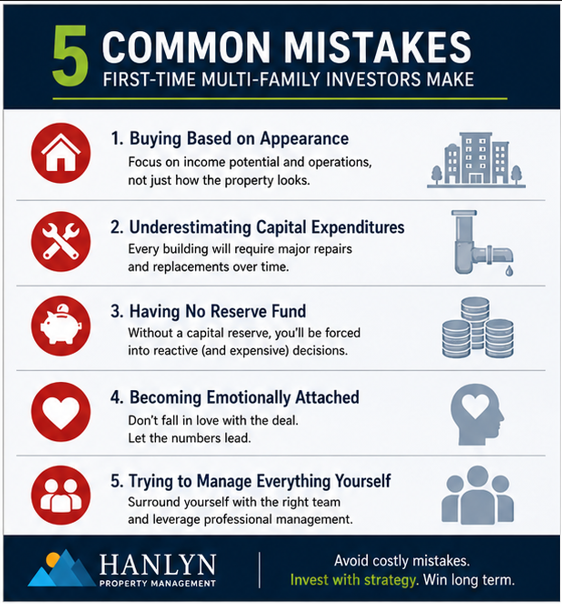
One of the most important mindset shifts a new investor must make is recognizing that an apartment building is fundamentally a business, not simply a piece of real estate. New buyers often spend considerable time evaluating the condition of the roof, the appearance of the hallways, or the curb appeal of the property. While those items certainly matter, the true value of an apartment building is determined by its ability to generate income. A building with below-market rents, operational inefficiencies, and opportunities for improvement may be significantly more attractive than a pristine property that has already been optimized by a sophisticated owner. The goal should not be to purchase the nicest building available. The goal should be to purchase a building that offers the greatest opportunity to create value through improved operations.
Understanding the relationship between net operating income and property value is perhaps the most powerful concept in apartment investing. Unlike residential real estate, where value is often influenced by comparable sales, apartment buildings are largely valued based on the income they generate. This creates significant opportunities for investors who understand how to improve a property’s performance. If an owner can increase annual net operating income by $20,000 through rent optimization, expense reductions, or operational improvements, that increase can have a dramatic impact on the property’s value. At a five percent capitalization rate, a $20,000 increase in annual net operating income can create approximately $400,000 in additional asset value. This is why experienced investors become obsessed with improving building operations. Small improvements in income and expenses can generate returns that far exceed the original investment.
Many first-time investors underestimate the importance of capital improvements and overestimate the importance of cosmetic appearance. While fresh paint and attractive landscaping can certainly improve a property’s presentation, the most impactful capital investments are often the least glamorous. Upgrading plumbing systems, improving energy efficiency, replacing aging mechanical equipment, modernizing electrical infrastructure, and implementing water conservation measures can significantly improve both tenant satisfaction and long-term profitability. Strategic renovations also create opportunities to increase rents during tenant turnover, which can further improve net operating income and ultimately increase the value of the asset. Successful investors view capital expenditures not as expenses, but as investments that generate future returns.
At the same time, investors must recognize that every building will eventually require significant capital expenditures. One of the most common mistakes I encounter is the assumption that positive cash flow means a property is financially healthy. In reality, a building may appear profitable while quietly accumulating future liabilities. Roofs eventually need replacement. Parking lots deteriorate. Boilers reach the end of their useful life. Windows fail, plumbing systems age, and common areas require modernization. Investors who fail to budget for these inevitable expenses often find themselves facing difficult financial decisions at precisely the wrong time. Establishing a dedicated capital reserve fund from the outset is one of the most prudent decisions a building owner can make. A healthy reserve allows investors to address major projects proactively rather than reactively and helps protect both cash flow and asset value over the long term.
Another lesson that many investors learn the hard way is the importance of maintaining a margin of safety. Real estate projections frequently look excellent on spreadsheets because spreadsheets assume everything goes according to plan. In reality, vacancies occur, tenants move unexpectedly, contractors uncover hidden issues, insurance premiums increase, and municipal taxes rise. Economic conditions can change quickly, and financing markets can become more challenging with little warning. Investors who stretch every dollar to complete an acquisition often discover that ownership becomes significantly more stressful when unexpected costs arise. Maintaining sufficient liquidity after closing provides flexibility, reduces risk, and allows owners to make rational decisions rather than emotional ones when challenges inevitably occur.
The psychological side of investing is often overlooked, yet it plays a significant role in long-term success. Many first-time buyers become emotionally attached to a property before they complete their due diligence. Once this happens, they begin searching for reasons to justify the acquisition rather than reasons to question it. Experienced investors approach opportunities differently. They actively look for flaws, risks, and assumptions that may prove incorrect. They understand that walking away from a deal can sometimes be the most profitable decision they make all year. Emotional discipline is one of the most valuable skills an investor can develop because poor acquisitions can take years to overcome, while a missed opportunity can usually be replaced with another.
Investors should also remember that apartment buildings are ultimately people businesses. While financial analysis is critical, tenant quality often has a greater impact on day-to-day performance than almost any other variable. Stable, respectful tenants reduce turnover, preserve property condition, improve collections, and create a more positive living environment for everyone involved. Buildings experiencing frequent tenant turnover often incur significantly higher costs related to leasing, maintenance, cleaning, and administration. Effective tenant screening, professional communication, and consistent property management practices can dramatically improve both financial performance and investor satisfaction.
One of the most common tendencies among new investors is the desire to personally manage every aspect of the operation. While this may seem like a cost-saving strategy, it often limits growth and creates unnecessary stress. As portfolios expand, the complexity of managing maintenance requests, leasing activities, contractor coordination, compliance requirements, and tenant relations increases substantially. Successful investors eventually recognize that their highest-value activities involve acquisitions, financing, strategy, and asset management rather than day-to-day operations. Building the right team and implementing effective systems allows owners to focus on growing their business while ensuring the property continues to operate efficiently.
Finally, first-time investors should think about their exit strategy before they complete their purchase. While most buyers focus exclusively on acquisition, successful investors also consider who their future buyer may be. Properties with strong locations, efficient layouts, stable occupancy, and opportunities for continued rent growth tend to attract a wider pool of future purchasers. Thinking several years ahead encourages better decision-making today and often results in acquiring assets that perform well throughout the entire investment lifecycle.
Multi-family investing can be an extraordinary vehicle for building wealth, but success rarely comes from market timing or speculation. Instead, it comes from disciplined underwriting, thoughtful capital planning, operational excellence, and the ability to make rational decisions when others become emotional. The investors who consistently outperform are not necessarily the ones who buy the most buildings. They are the ones who understand how apartment buildings create value and who remain focused on the fundamentals that drive long-term success. By approaching your first acquisition with patience, preparation, and a commitment to continuous improvement, you can position yourself to enjoy the many rewards that multi-family investing has to offer.
All Access