
Wheatland County Is Not Waiting for Growth. It Is Building It
Heather Fabris I Realtor® I Residential & Commercial
Smart investors do not wait for the headline. They follow the industrial announcements, the rezoning applications, and the municipal development plans that most people scroll past. Wheatland County, Alberta is flashing those signals right now, and the window to act ahead of the broader market is still open.
Two Major Commitments. One Geography. One Question.
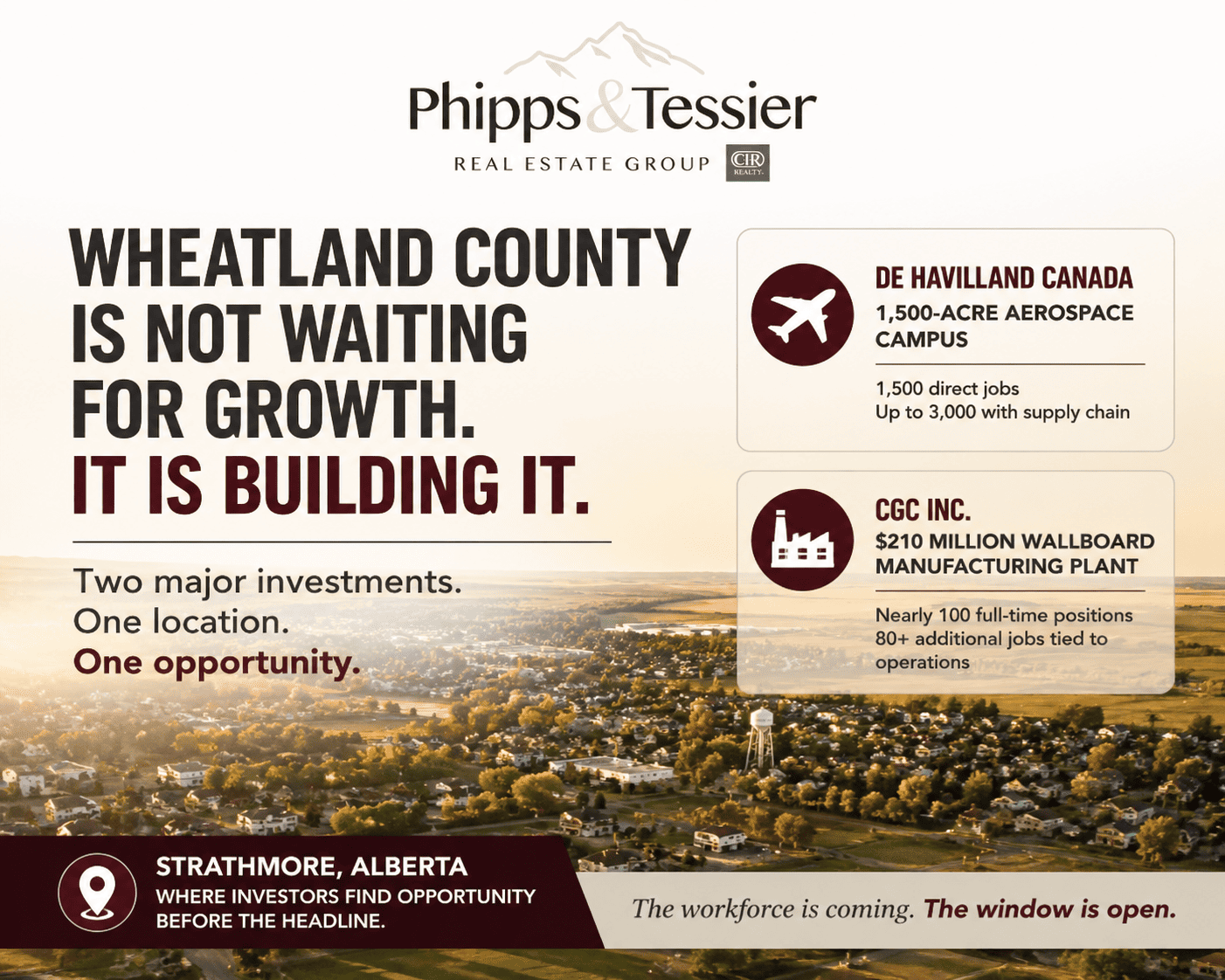
In May 2026, De Havilland Canada broke ground on De Havilland Field, a 1,500-acre aerospace campus 11 kilometres west of Strathmore. The facility will serve as the final assembly site for the DHC-515 water bomber, the DHC-6 Twin Otter, and the Dash 8-400, with a projected 1,500 direct jobs and up to 3,000 when the supply chain ecosystem is included. The province has called it the largest private aviation investment in Alberta’s history.
Days later, on June 10, 2026, CGC Inc. opened its brand new $210 million wallboard manufacturing plant in the same county. The 220,000-square-foot facility is already producing Sheetrock-brand drywall and shipping it to customers across western Canada. It has created nearly 100 full-time positions with approximately 80 additional jobs tied to plant operations and related economic activity in the region.
Two entirely unrelated industries independently chose the same geography within a short window. That is not a coincidence. It is a signal. Both companies conducted rigorous site selection processes and arrived at the same conclusion: Wheatland County offers affordable industrial land, direct Trans-Canada Highway access, proximity to Calgary’s labour pool, and a municipal government that moves efficiently to attract investment. When sophisticated capital aligns like this, residential real estate demand follows.
The question every investor should be asking: where do those workers live?
Another lesson that many investors learn the hard way is the importance of maintaining a margin of safety. Real estate projections frequently look excellent on spreadsheets because spreadsheets assume everything goes according to plan. In reality, vacancies occur, tenants move unexpectedly, contractors uncover hidden issues, insurance premiums increase, and municipal taxes rise. Economic conditions can change quickly, and financing markets can become more challenging with little warning. Investors who stretch every dollar to complete an acquisition often discover that ownership becomes significantly more stressful when unexpected costs arise. Maintaining sufficient liquidity after closing provides flexibility, reduces risk, and allows owners to make rational decisions rather than emotional ones when challenges inevitably occur.
They Are Planning to Build a Town.
At the De Havilland groundbreaking, it was confirmed that the long-term plan includes building a residential community adjacent to the facility to house employees and their families. Companies do not build towns for operations they are uncertain about. That announcement signals a generational commitment to this location.
But here is where the investor opportunity sits. That company community is tied to a ten to fifteen year build-out. The workforce arriving in the near term needs housing now. The only market available to meet that demand is the existing private residential market in Strathmore and surrounding communities. And not every employee will want to live in company-provided housing. Independent rental and ownership options in Strathmore will appeal to a significant portion of that workforce regardless of what De Havilland builds on site.
The Market is Already Responding.
Strathmore developers have reported strong lot sales driven directly by the De Havilland announcement. That is the market pricing in a signal, not a result.
Strathmore’s population reached over 16,400 in 2025, representing nearly 10 per cent growth over five years, and that trajectory was established before either industrial facility reached operational scale. In 2024 alone, the town recorded $30.6 million in building permit value. Local developers describe rental supply as limited and resale inventory as tight. The workforce has not fully arrived yet.
The numbers confirm it. Strathmore’s residential vacancy rate sits at 1.60 per cent as of 2025. A balanced market falls between 3 and 5 per cent. Strathmore is less than half that lower bound. Average rent for a two-bedroom unit hit $1,500 per month in 2024, up 22.6 per cent from the prior year. There is $290 million in major private sector projects proposed or under construction. Supply is moving. It is not keeping pace with what is coming.
Where the Opportunity Is Right Now.
Affordable Entry Points. Calgary pricing has pushed many buyers and renters east. Strathmore is where affordability still exists, and for investors, that is where the number work.
Rental Supply. Strathmore’s rental inventory is limited and demand is growing. For investors, that gap represents immediate opportunity.
The Company Town Gap. De Havilland’s employee housing is a long-horizon project. The near and medium-term demand from arriving workers will be absorbed by the private market. That is a multi-year runway for investors who are positioned now.
Commercial Follow-Through. A growing workforce drives demand for grocery, healthcare, childcare, and professional services. The commercial and mixed-use opportunity in Strathmore is real and still early.
The CGC plant is open. De Havilland has broken ground. A company town is being planned. The workforce is coming. The investors who will look back on this market with satisfaction are the ones who recognized the signal before it became a headline.
If you want to talk through what this means for your portfolio, reach out to our team. We are on the ground in this market, we know the numbers, and the conversation costs you nothing.
Sources: De Havilland Canada, CGC Inc., Wheatland County, Airways Magazine, Wings Magazine, Strathmore Times, Alberta Regional Dashboard
All Access